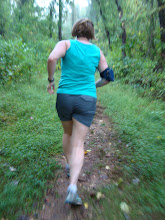
I was driving home from work earlier this week, dreading the first 10-mile long run of this year's marathon training season, when I heard a familiar name on the radio: Dr. Murray! WAMU was airing a story on the 4th anniversary of her death and the 5th year of the camp she founded. You can listen here:
http://wamu.org/programs/metro_connection/13/06/21/family_friends_remember_girlsup_camp_founder
This morning, as I was slogging through that first 10-mile run, I thought about Dr. Murray: how she helped inspire me to run my first marathon and how she continues to inspire me as I embark on training for marathons #4 and #5. If you need a little inspiration, listen to her story!
Showing posts with label Dr. Murray. Show all posts
Showing posts with label Dr. Murray. Show all posts
Saturday, June 29, 2013


Saturday, October 30, 2010
Good luck charms.


With less than 24 hours to go (!), I'm making all of the final arrangements and packing up my stuff for the big race. This includes the all-important good luck charms, pictured above. In the first picture, we have the "walk it off" bracelet (which has come to symbolize everything Katie, Erin, Val and I went through to get to this day), a "courage" coin that I received as part of my grief counseling experience, a "footprints" coin (an inside joke from Katie), and most important- a note from one of the Murray girls. I had the opportunity to meet three of Dr. Murray's amazing daughters this summer and I've had this note on my refrigerator for inspiration ever since. In the second picture, you can see the reverse of the note, which is a picture of all the Murray girls. The one in the top right is Sloane, who died along with Dr. Murray. This photo is the most important thing I'll have with me tomorrow because it reminds me of why I put myself through this in the first place!
Speaking of Dr. Murray, the fundraising grand total stands at $3301 right now. Tomorrow, the fundraising sites will close and we would love to have at least $3500 when they do. If you want to donate, do it now and do it on Katie's page (since I met my personal goal already): http://www.active.com/donate/marathonformurray2. Thanks as always for your support!
Thursday, October 28, 2010
Papers, panic, pasta and prayers.
Hello, friends! I am writing this from my current location under a pile of books and papers. As I may have mentioned before, the week before my marathon of running just happens to include a marathon of homework, church meetings, family stuff and a variety of other distractions. All of this is leaving little time for panic (except about schoolwork) or blogging (boo!).
My toughest assignment is due at 4:15pm today, so I am down to the wire, but I do want to take a minute to say a big thank you to the Noodles and Company in Columbia, MD. Katie and I had hoped to hold a fundraiser there this week, but all of our work got the better of us and we were not able to pull it together. We were worried that the Noodles people would be angry, but instead they offered us free pasta for our carb-loading week! So, tonight, after Katie and I both turn in this *&%$*# paper, we will be off to Katie's for a pasta party with our awesome running buddies. I can't wait.
While I have nothing else original to offer on the blog today, I had the opportunity yesterday to give a short reflection on my training/fundraising experience before one of my classes. Most of this material is recycled from other blog posts, but I thought I would post it anyway:
Marathon for Murray reflection, 10/27/10
Kelly and Sloane died on a Friday. I didn’t find out about it for a couple of days because I was busy writing a sermon about Mark 5: 21-43.This is the story where Jesus heals a woman who has been suffering hemorrhages for 12 years and also revives Jairus’ young daughter, who has just died. I really struggled with this sermon. Personally, I find the miracle stories difficult because they make me wonder why we don’t see more miracles, and why we see so many good, faithful people suffer and die.
To find a way to talk about the text, I thought about what we mean when we say the word, “miracle,” and I decided that we usually think of miracles as instant, wonderful solutions to our worst problems. Then, I looked back at the Bible story, and I realized that these healings were not instant, wonderful solutions. The people in the stories had to work hard and suffer a long time before their problems were solved. Even then, the solutions they received were quite different than what they originally hoped for.
Ultimately, I wrote:
“I think that the good news of today’s text is that miracles aren’t always simple or immediate, but they do happen. The people in today’s stories have to make long and difficult journeys in order to receive healing, and it might not happen exactly as they want or expect it to. Given a choice, I’m sure that the woman with hemorrhages would not have endured 12 years of sickness and lost everything she had before finding a cure. I’m sure that Jairus would have chosen for his daughter not to get sick and die in the first place. When that moment of healing comes, though, none of that matters. When these people finally feel the healing touch of Jesus, they forget all the struggle and pain, and simply feel awe and gratitude for the miracle they’ve received.”
That Sunday morning, I was getting ready to go and preach this sermon when I turned on the TV and learned that Kelly and Sloane had died. I drove to the church sobbing and I had no idea how I was going to stand behind the pulpit and talk about healing and resurrection. The one thing that got me through it was something that one of my preaching professors in seminary told me. He said that we should always preach the message we most need to hear. The morning that I gave that sermon was the truest expression of that lesson I can imagine. I needed more than anything to believe that healing from the kind of pain so many were experiencing that day could be possible, no matter how long or what form it took.
In the days after Kelly and Sloane died, I thought a lot about what I needed to learn from those losses. I kept coming back to how much Kelly had experienced and accomplished in only 40 years. I was 30 at that time, and I thought about what I would want to do if I knew I only had 10 more years. I decided that I needed to stop holding myself back and push myself to try new things and be as excellent as I knew I could be.
On the anniversary of Kelly and Sloane’s accident, I went to a memorial mass in their honor. Kelly’s husband Sean spoke about how he and his daughters are coping. He admits that they are still struggling, but he said that the thing that gives them hope is learning about all of the ways Kelly and Sloane have impacted and inspired others. I knew exactly what he meant. When I made my resolution to push myself, I was thinking about my personal and professional lives. Running was the furthest thing from my mind. But, as I learned from the Bible story, healing often comes in unexpected ways. I don’t have adequate time or words to explain the blessings that have come into my life since I decided to run this marathon in honor of Kelly. I can only say that it has been transformative, and I don’t know that I would have done it without Kelly and Sloane’s inspiration.
So, I want to leave you with the conclusion of that sermon I gave a little over a year ago. I’ll be the first to admit that I wasn’t sure I believed it at the time. But I believe it now:
“As we sit here [today], I’m sure that each of us is need of some form of healing, whether from physical disease, mental illness, emotional pain, spiritual emptiness, or any number of other hurts. I’m also sure that, at one time or another, we’ve all wished for a miracle. The good news of this text is that it might not happen immediately or exactly how we want it, but if we persevere, believe, and support one another, our own miraculous moments of healing will come. Sooner or later, our faith will make us well. Amen.”
My toughest assignment is due at 4:15pm today, so I am down to the wire, but I do want to take a minute to say a big thank you to the Noodles and Company in Columbia, MD. Katie and I had hoped to hold a fundraiser there this week, but all of our work got the better of us and we were not able to pull it together. We were worried that the Noodles people would be angry, but instead they offered us free pasta for our carb-loading week! So, tonight, after Katie and I both turn in this *&%$*# paper, we will be off to Katie's for a pasta party with our awesome running buddies. I can't wait.
While I have nothing else original to offer on the blog today, I had the opportunity yesterday to give a short reflection on my training/fundraising experience before one of my classes. Most of this material is recycled from other blog posts, but I thought I would post it anyway:
Marathon for Murray reflection, 10/27/10
Kelly and Sloane died on a Friday. I didn’t find out about it for a couple of days because I was busy writing a sermon about Mark 5: 21-43.This is the story where Jesus heals a woman who has been suffering hemorrhages for 12 years and also revives Jairus’ young daughter, who has just died. I really struggled with this sermon. Personally, I find the miracle stories difficult because they make me wonder why we don’t see more miracles, and why we see so many good, faithful people suffer and die.
To find a way to talk about the text, I thought about what we mean when we say the word, “miracle,” and I decided that we usually think of miracles as instant, wonderful solutions to our worst problems. Then, I looked back at the Bible story, and I realized that these healings were not instant, wonderful solutions. The people in the stories had to work hard and suffer a long time before their problems were solved. Even then, the solutions they received were quite different than what they originally hoped for.
Ultimately, I wrote:
“I think that the good news of today’s text is that miracles aren’t always simple or immediate, but they do happen. The people in today’s stories have to make long and difficult journeys in order to receive healing, and it might not happen exactly as they want or expect it to. Given a choice, I’m sure that the woman with hemorrhages would not have endured 12 years of sickness and lost everything she had before finding a cure. I’m sure that Jairus would have chosen for his daughter not to get sick and die in the first place. When that moment of healing comes, though, none of that matters. When these people finally feel the healing touch of Jesus, they forget all the struggle and pain, and simply feel awe and gratitude for the miracle they’ve received.”
That Sunday morning, I was getting ready to go and preach this sermon when I turned on the TV and learned that Kelly and Sloane had died. I drove to the church sobbing and I had no idea how I was going to stand behind the pulpit and talk about healing and resurrection. The one thing that got me through it was something that one of my preaching professors in seminary told me. He said that we should always preach the message we most need to hear. The morning that I gave that sermon was the truest expression of that lesson I can imagine. I needed more than anything to believe that healing from the kind of pain so many were experiencing that day could be possible, no matter how long or what form it took.
In the days after Kelly and Sloane died, I thought a lot about what I needed to learn from those losses. I kept coming back to how much Kelly had experienced and accomplished in only 40 years. I was 30 at that time, and I thought about what I would want to do if I knew I only had 10 more years. I decided that I needed to stop holding myself back and push myself to try new things and be as excellent as I knew I could be.
On the anniversary of Kelly and Sloane’s accident, I went to a memorial mass in their honor. Kelly’s husband Sean spoke about how he and his daughters are coping. He admits that they are still struggling, but he said that the thing that gives them hope is learning about all of the ways Kelly and Sloane have impacted and inspired others. I knew exactly what he meant. When I made my resolution to push myself, I was thinking about my personal and professional lives. Running was the furthest thing from my mind. But, as I learned from the Bible story, healing often comes in unexpected ways. I don’t have adequate time or words to explain the blessings that have come into my life since I decided to run this marathon in honor of Kelly. I can only say that it has been transformative, and I don’t know that I would have done it without Kelly and Sloane’s inspiration.
So, I want to leave you with the conclusion of that sermon I gave a little over a year ago. I’ll be the first to admit that I wasn’t sure I believed it at the time. But I believe it now:
“As we sit here [today], I’m sure that each of us is need of some form of healing, whether from physical disease, mental illness, emotional pain, spiritual emptiness, or any number of other hurts. I’m also sure that, at one time or another, we’ve all wished for a miracle. The good news of this text is that it might not happen immediately or exactly how we want it, but if we persevere, believe, and support one another, our own miraculous moments of healing will come. Sooner or later, our faith will make us well. Amen.”
Thursday, September 16, 2010
Some other important numbers.
A few minutes ago, I wrote about my race number, 20398. Here are a few more important numbers:
7- On Sunday, that will be the number of weeks left until the race.
$1295.00- That's how much Katie and I have raised, combined, to date for the Kelly Murray Scholarship Fund at Loyola.
$5000.00- That's how much Katie and I would like to raise by the marathon on Oct. 31.
$3705.00- That's how much more we need to raise to reach our goal.
If you have been meaning to donate, but haven't done it yet, there's no time like the present! All you have to do is visit http://www.active.com/donate/marathonformurray (my site) or http://www.active.com/donate/marathonformurray2 (Katie's site). If you would prefer to mail a check, email me and I'll tell you how (aliciakimbrooks@gmail.com).
You can also help by telling friends and family about this fundraiser, especially people connected to Dr. Murray and/or Loyola.
I haven't even run the race yet, and this marathon has already changed my life in many ways. Please help Katie and I use this experience to change the lives of some deserving students as well!
7- On Sunday, that will be the number of weeks left until the race.
$1295.00- That's how much Katie and I have raised, combined, to date for the Kelly Murray Scholarship Fund at Loyola.
$5000.00- That's how much Katie and I would like to raise by the marathon on Oct. 31.
$3705.00- That's how much more we need to raise to reach our goal.
If you have been meaning to donate, but haven't done it yet, there's no time like the present! All you have to do is visit http://www.active.com/donate/marathonformurray (my site) or http://www.active.com/donate/marathonformurray2 (Katie's site). If you would prefer to mail a check, email me and I'll tell you how (aliciakimbrooks@gmail.com).
You can also help by telling friends and family about this fundraiser, especially people connected to Dr. Murray and/or Loyola.
I haven't even run the race yet, and this marathon has already changed my life in many ways. Please help Katie and I use this experience to change the lives of some deserving students as well!
Monday, June 28, 2010
No Turning Back
I preached this sermon at St. Andrew's UMC in Edgewater, MD on June 27, 2010. The earlier sermon referenced in this one is in my post from June 24th.
Luke 9:51-62
When the days drew near for him to be taken up, he set his face to go to Jerusalem. And he sent messengers ahead of him. On their way they entered a village of the Samaritans to make ready for him; but they did not receive him, because his face was set toward Jerusalem. When his disciples James and John saw it, they said, “Lord, do you want us to command fire to come down from heaven and consume them?” But he turned and rebuked them. Then they went on to another village.
As they were going along the road, someone said to him, “I will follow you wherever you go.” And Jesus said to him, “Foxes have holes, and birds of the air have nests; but the Son of Man has nowhere to lay his head.” To another he said, “Follow me.” But he said, “Lord, first let me go and bury my father.” But Jesus said to him, “Let the dead bury their own dead; but as for you, go and proclaim the kingdom of God.” Another said, “I will follow you, Lord; but let me first say farewell to those at my home.” Jesus said to him, “No one who puts a hand to the plow and looks back is fit for the kingdom of God.”
No Turning Back:
Luke 9:51-62
Some of you may have noticed that I wasn’t in church last Sunday. Instead, I was out on the B&A Trail in Severna Park, sweaty and exhausted, asking myself a question I ask a lot these days: “What am I doing here?” I’m currently training for my first full marathon- a 26.2 mile road race. My training plan includes a number of other races, with distances ranging from 1 mile to 17. Last Sunday, it was a 10K, or 6.2 miles. The distance wasn’t a problem; the problem was the heat. By the halfway point, the sun was beating down so hard that I could only think of two things: finishing the race, and the fact that I would be back out in less than a week for a 10-mile run. Neither of those things felt possible at the time, but I knew that I had gone too far to turn back.
Last Sunday’s starting line was at Severna Park High School, but the true starting line of my marathon journey was right here in this pulpit one year ago. Last year, on the last Sunday in June, I agreed to preach while Pastor Dave was on vacation, just like I’m doing now. I spent the whole weekend wrestling with the text- a story from Mark about two of Jesus’s miraculous healings. I struggled with how to relate the miracle stories of Biblical times to our modern, scientific era. After a whole weekend of thinking and writing, I finally came to some hopeful conclusions about the possibility of miraculous healing in our time.
One of my preaching professors in seminary told me that I should always preach the word that I most need to hear. The morning I preached that sermon, I learned what he meant. Just a few minutes before I left for church, I turned on the news and saw a picture of one of my all-time favorite teachers, Dr. Kelly Murray from the Pastoral Counseling program at Loyola. I learned that Kelly and her 7 year-old daughter Sloane had been killed in a freak accident earlier that weekend. I cried the whole way from my house to St. Andrew’s. I was overwhelmed by the loss of a brilliant, talented woman who had already given so much to the world and could have given so much more. I thought about Kelly’s husband and her five other daughters. The confident words I had written about healing suddenly seemed hollow. How could anyone possibly heal from something like this?
Preaching that morning was one of the hardest things I’ve ever done. It took every ounce of strength I had just to collect myself and walk to the pulpit. When I got there, I dedicated the sermon to Kelly and Sloane and prayed for the confidence to believe my own message of hope. After the first service, a visitor to the church came up to me and shared how she was struggling with a tragedy in her own family. She said that I had preached the word she most needed to hear. Despite my own despair, I had given her hope that she could heal.
I’ve thought about that conversation many times over the last year. I thought about it as I attended memorial services for Kelly and Sloane. I think about it now when I go to Loyola and don’t see Kelly there. I don’t think I’ll ever understand why Kelly and Sloane had to die, but preaching that day helped me find some meaning in the tragedy. I realized that I need to honor my beloved professor by living out what she taught me. Kelly had many great qualities, but the one that impressed me most was her excellence. When she cared about something, she committed herself to it completely and never settled for less than her best. In the days and weeks after her death, I realized that I need to follow her example and push myself to be more excellent in everything I do. The morning I gave that sermon, I pushed myself to do something that seemed impossible. Through that decision, I continued Kelly’s legacy of teaching and healing.
All year, I’ve been looking for more opportunities to be excellent, which is how I found the marathon. At Kelly’s memorial service, one of her friends talked about her passion for running. She explained that Kelly had been training for her first marathon when she got pregnant with her 6th child. She died only a few months after that child was born, so she never got to finish her race. A few months after hearing that story, my classmate Katie and I had an idea: we would finish Kelly’s race for her. We would run our first marathons, and we would use our races to raise money for a scholarship in honor of Kelly.
We approached the Loyola faculty about our idea and they loved it. Within a couple of weeks, we had personal fundraising websites, training blogs, business cards, and flyers about our campaign. If you go to the Loyola Pastoral Counseling website right now, our story is the first thing you see. We’ve already collected close to $1,000. For Katie and I, there is truly no turning back now. As hot as it gets, as exhausted as we feel, as impossible as the task before us seems, we’ve committed ourselves to this and we need to see it through.
This kind of commitment is at the heart of today’s Gospel lesson. I find Jesus’s tone in this text a little harsh, but I think I understand what he’s getting at. Jesus is making it clear that being a Christian isn’t a hobby, a nice thing to do a few times a year, or a single priority to be balanced with others. Being a Christian is a commitment, a decision to make following Jesus our top priority for our whole lives. Being a Christian means no turning back. If we want to follow Jesus, he needs us to understand that the journey will be long and hard. In this text, he gives us several good reasons why:
First, being a Christian means sacrificing peace, security, and the dream of a simple life. Right now, I’m very focused on finishing my marathon. I have thousands of dollars left to raise and hundreds of miles left to run before I cross the finish line. Still, I’ve already asked myself the all-important question “Then what?” Will I just stay home and rest? I could, but would that honor my commitment to be excellent? If I truly want to continue this journey, I’ll have to find a new challenge. Once I achieve that, I’ll need another one. Books written for first-time marathoners all devote at least one chapter to the “What’s next?” question. Experienced runners know that, once someone tackles a marathon, they will never be satisfied just sitting home. They will always be on the lookout for the next challenge.
Truly being a Christian also means never resting. When Jesus says that “the Son of Man has nowhere to lay his head,” he means it quite literally. When he started his ministry, he gave up not just his home, but the idea of having a home at all. Jesus and his disciples wandered from town to town, depending on the hospitality of strangers for all of their needs. To a lesser degree, our Methodist clergy do the same thing today. When Pastor Dave and Rev. Nowers were ordained, they surrendered their freedom to decide where to live and work. They agreed to go wherever they were sent for their entire careers. Every year of his career in ministry, Rev. Nowers faced the possibility of being uprooted to a new church, a new town, a new home. Pastor Dave still lives with this uncertainty. Until they retire, Methodist clergy can never call a single place “home.”
Even if we are not called to be clergy, being a Christian requires letting go of security and comfort, and taking on a project that will never be completed. As Christians, all of us have the same goals: obedience to God and imitating Jesus. How many of us can honestly say that we’ve achieved those goals, that we have no more work to do and can rest? How many of us honestly believe that we’ll ever achieve those goals in our lifetimes? Being a Christian means striving for a finish line you never expect to reach. Being part of a church is the same way. Have you ever noticed that the work of this church is never done? I’ve been here my entire life, over 31 years, and I can’t remember a time when people weren’t talking of a need to fundraise in order to stay afloat. I can’t remember a time when people weren’t looking for help with a new project or mission. No matter how well we succeed in a single fundraising effort or project, the next one is always right around the corner. If you’re looking for a place to feel rested and at peace, stay away from church.
Being a Christian also requires letting go of our hesitation and making a decision. I’ve owned my house in Eastport for 7 years, and there’s been a gym right down the street that entire time. For 6 of those 7 years, I had really good reasons for not joining. I was in school, I was busy, the gym was too expensive, and I could find plenty of ways to exercise without it. I had visions of myself as a healthy person who exercised regularly, but I never seemed to get there. Last summer, when I finally decided to join the gym, all of those excuses were still there: I was still in school, I was busier than ever, the gym was still expensive, and I could still find ways to exercise without it. My reasons for not joining didn’t go away; I just realized that my reasons for joining were better. And something amazing happened: when I started going go the gym every day, I stopped imagining myself as a healthy, fit person and I actually became a healthy, fit person.
Jesus also calls us let go of our excuses and make a decision. When I first read his words to the man who wishes to bury his father “Let the dead bury their dead,” it sounded very harsh to me. Why shouldn’t this man take time to grieve and support his family? Being with one’s family after a death is not a bad thing, so why is Jesus against it? The more I think about it, though, I don’t think that Jesus is saying that loyalty to one’s family is a bad thing. I think he’s saying that, in order to make a real commitment, we need to reach a point where there are no more excuses.
Sitting here today, I’m sure that many of us have visions of ourselves as better people and better Christians. We might imagine ourselves getting more involved in the church, spending more time in prayer and meditation, or being better spiritual role models for our friends and families. Our reasons for not making these visions a reality may be perfectly valid: we might feel inadequate, we might be overwhelmed by other commitments, or we might simply be distracted by other important things in our lives. Whatever our excuses, Jesus wants us to understand that we must get past them if we want to truly follow him. If we’re waiting for a time when we’ll be free from other commitments and able to focus all our attention on being Christians, then we’ll spend our whole lives waiting. If we want to follow Jesus, we have to make a decision to drop everything and go.
Finally, Jesus wants us to know that being a Christian is lonely sometimes. It means breaking away from the security of what we know and venturing alone into the unknown. Two weekends ago, I volunteered at a weekend grief camp for children and teenagers- the same camp that so many of you donated to back in March. I can assure you that your donations went to good use, because the camp was absolutely wonderful. Everyone at camp- all of the children, all of the staff, all of the volunteers- had experienced the death of a loved one. And we all shared our losses together- the adults right alongside the children. I was amazed at the amount of healing that could take place in only 3 days. Do you know what made that healing possible? No cell phones. No computers. No Ipods. No contact with the world outside our small camp for the entire weekend.
When I first heard about that rule, I wasn’t sure how it would go. Pretty much everyone at camp was separated from something that gives them safety and security. Small children were separated from their caregivers. Teenagers and adults were separated from the constant connection to friends and family which we’ve all grown so accustomed to. I’ll be the first to admit that it wasn’t easy for me to turn off my Blackberry and leave it in the car. Once I did, though, I was amazed at what I experienced. All weekend, everywhere I looked, I saw people 100% engaged with one another. Children and adults having long, deep conversations. Teenage boys singing camp songs and completing art projects without worrying what their friends would think. At our volunteer training, we were told that camp would involve giving with our whole hearts. I know that was true for me, and I couldn’t have done it if I had been checking my Blackberry every 10 minutes.
In Jesus’s time, becoming a Christian meant leaving all safety and security behind. In a totally family-centered society, followers of Jesus took the unprecedented step of leaving their homes and families to join his ministry. Many of the Christian monastics and mystics went even further, moving alone into the desert or cloistering themselves in tiny communities to commune with God. They did this, not because they believed that their families or communities were bad, but because they felt a need to eliminate all distractions from their spiritual callings.
Today, most of us aren’t required to make such dramatic sacrifices in order to become Christians. As Christians living in the United States in 2010, we have it pretty easy. Many of us are blessed with families and friends who support or even share of our beliefs. Most of us can be Christians and remain in our homes and our professions. Being a Christian is socially acceptable- its even a political advantage. While this freedom is certainly a blessing, I think it also makes us complacent. We get so used to being comfortable as Christians that we avoid from those situations where being a Christian should make us uncomfortable. A relative or colleague makes a racist remark and we fail to challenge them. We go to the mall and buy things without thinking about how they were made or whether there might be a better use for our money. We see people in need and tell ourselves that they must have done something to deserve their situation. All too often, we let our desire for comfort and social acceptance prevent us from taking the courageous stands we know we should. We need to let go of these distractions if we ever hope to make our faith the center of our lives.
In this morning’s text, Jesus gives us plenty of good reasons why following him will be hard. Yet, that’s what he calls us to do and that’s what we’re all here to do. So how do we do it? How do we set our feet on the right path and resist the temptation to look back? I think that we do it together. Its true that Jesus asks us to leave our places of safety and security and set out alone to follow him. Once we begin our journey, though, we find companions. A year ago this weekend, I found the courage to walk to this pulpit alone and that visitor found the courage to come to this church alone. It wasn’t easy, but once we set out, we found each other. Two weeks ago, a large group of children and volunteers took the risk of setting out for camp alone, not knowing what would happen when we got there. By the end of the weekend, we had transformed from individuals to a community of people helping each other heal.
The companions we meet on our Christian journey help us carry on, even when it feels impossible. I can’t tell you how many times I’ve come home from a run exhausted, feeling like I’ll never be able to finish my race, and found an encouraging email from someone at Loyola. I can’t tell you how many times I’ve walked into this church exhausted, feeling like following my call to ministry is just too hard and been encouraged by all of your kind words and support. If I had never risked setting out on these journeys, I would never have encountered such wonderful people.
The companions we meet on our Christian journey can even help us face the reality that we may never see our destination. My professor Kelly was a woman who was passionate about healing people in pain. Yet, as gifted as she was, she could never have healed everyone. By sharing her faith and her gifts with others, she ensured that there would be plenty of us to carry on her work even after she was gone. In the Book of Hebrews, chapter 11, Paul talks about our Hebrew ancestors who heeded God’s call to leave their homes and journey to the promised land. He writes “All of these died in faith without having received the promises, but from a distance they saw and greeted them… If they had been thinking of the land that they had left behind, they would have had opportunity to return. But as it is, they [desired] a better country, that is, a heavenly one. Therefore God… has prepared a city for them.”
Deciding to follow Jesus isn’t easy. It can be exhausting. It can be lonely. It can require us to make hard choices. At times, it can feel hopeless. We can only do it if we make a commitment, set our faces toward our goal, and decide that there will be no turning back. But if we can leave our places of safety and security and take those first steps into the unknown, then we’ll find those wonderful companions who will help us reach the city of God. Amen.
Luke 9:51-62
When the days drew near for him to be taken up, he set his face to go to Jerusalem. And he sent messengers ahead of him. On their way they entered a village of the Samaritans to make ready for him; but they did not receive him, because his face was set toward Jerusalem. When his disciples James and John saw it, they said, “Lord, do you want us to command fire to come down from heaven and consume them?” But he turned and rebuked them. Then they went on to another village.
As they were going along the road, someone said to him, “I will follow you wherever you go.” And Jesus said to him, “Foxes have holes, and birds of the air have nests; but the Son of Man has nowhere to lay his head.” To another he said, “Follow me.” But he said, “Lord, first let me go and bury my father.” But Jesus said to him, “Let the dead bury their own dead; but as for you, go and proclaim the kingdom of God.” Another said, “I will follow you, Lord; but let me first say farewell to those at my home.” Jesus said to him, “No one who puts a hand to the plow and looks back is fit for the kingdom of God.”
No Turning Back:
Luke 9:51-62
Some of you may have noticed that I wasn’t in church last Sunday. Instead, I was out on the B&A Trail in Severna Park, sweaty and exhausted, asking myself a question I ask a lot these days: “What am I doing here?” I’m currently training for my first full marathon- a 26.2 mile road race. My training plan includes a number of other races, with distances ranging from 1 mile to 17. Last Sunday, it was a 10K, or 6.2 miles. The distance wasn’t a problem; the problem was the heat. By the halfway point, the sun was beating down so hard that I could only think of two things: finishing the race, and the fact that I would be back out in less than a week for a 10-mile run. Neither of those things felt possible at the time, but I knew that I had gone too far to turn back.
Last Sunday’s starting line was at Severna Park High School, but the true starting line of my marathon journey was right here in this pulpit one year ago. Last year, on the last Sunday in June, I agreed to preach while Pastor Dave was on vacation, just like I’m doing now. I spent the whole weekend wrestling with the text- a story from Mark about two of Jesus’s miraculous healings. I struggled with how to relate the miracle stories of Biblical times to our modern, scientific era. After a whole weekend of thinking and writing, I finally came to some hopeful conclusions about the possibility of miraculous healing in our time.
One of my preaching professors in seminary told me that I should always preach the word that I most need to hear. The morning I preached that sermon, I learned what he meant. Just a few minutes before I left for church, I turned on the news and saw a picture of one of my all-time favorite teachers, Dr. Kelly Murray from the Pastoral Counseling program at Loyola. I learned that Kelly and her 7 year-old daughter Sloane had been killed in a freak accident earlier that weekend. I cried the whole way from my house to St. Andrew’s. I was overwhelmed by the loss of a brilliant, talented woman who had already given so much to the world and could have given so much more. I thought about Kelly’s husband and her five other daughters. The confident words I had written about healing suddenly seemed hollow. How could anyone possibly heal from something like this?
Preaching that morning was one of the hardest things I’ve ever done. It took every ounce of strength I had just to collect myself and walk to the pulpit. When I got there, I dedicated the sermon to Kelly and Sloane and prayed for the confidence to believe my own message of hope. After the first service, a visitor to the church came up to me and shared how she was struggling with a tragedy in her own family. She said that I had preached the word she most needed to hear. Despite my own despair, I had given her hope that she could heal.
I’ve thought about that conversation many times over the last year. I thought about it as I attended memorial services for Kelly and Sloane. I think about it now when I go to Loyola and don’t see Kelly there. I don’t think I’ll ever understand why Kelly and Sloane had to die, but preaching that day helped me find some meaning in the tragedy. I realized that I need to honor my beloved professor by living out what she taught me. Kelly had many great qualities, but the one that impressed me most was her excellence. When she cared about something, she committed herself to it completely and never settled for less than her best. In the days and weeks after her death, I realized that I need to follow her example and push myself to be more excellent in everything I do. The morning I gave that sermon, I pushed myself to do something that seemed impossible. Through that decision, I continued Kelly’s legacy of teaching and healing.
All year, I’ve been looking for more opportunities to be excellent, which is how I found the marathon. At Kelly’s memorial service, one of her friends talked about her passion for running. She explained that Kelly had been training for her first marathon when she got pregnant with her 6th child. She died only a few months after that child was born, so she never got to finish her race. A few months after hearing that story, my classmate Katie and I had an idea: we would finish Kelly’s race for her. We would run our first marathons, and we would use our races to raise money for a scholarship in honor of Kelly.
We approached the Loyola faculty about our idea and they loved it. Within a couple of weeks, we had personal fundraising websites, training blogs, business cards, and flyers about our campaign. If you go to the Loyola Pastoral Counseling website right now, our story is the first thing you see. We’ve already collected close to $1,000. For Katie and I, there is truly no turning back now. As hot as it gets, as exhausted as we feel, as impossible as the task before us seems, we’ve committed ourselves to this and we need to see it through.
This kind of commitment is at the heart of today’s Gospel lesson. I find Jesus’s tone in this text a little harsh, but I think I understand what he’s getting at. Jesus is making it clear that being a Christian isn’t a hobby, a nice thing to do a few times a year, or a single priority to be balanced with others. Being a Christian is a commitment, a decision to make following Jesus our top priority for our whole lives. Being a Christian means no turning back. If we want to follow Jesus, he needs us to understand that the journey will be long and hard. In this text, he gives us several good reasons why:
First, being a Christian means sacrificing peace, security, and the dream of a simple life. Right now, I’m very focused on finishing my marathon. I have thousands of dollars left to raise and hundreds of miles left to run before I cross the finish line. Still, I’ve already asked myself the all-important question “Then what?” Will I just stay home and rest? I could, but would that honor my commitment to be excellent? If I truly want to continue this journey, I’ll have to find a new challenge. Once I achieve that, I’ll need another one. Books written for first-time marathoners all devote at least one chapter to the “What’s next?” question. Experienced runners know that, once someone tackles a marathon, they will never be satisfied just sitting home. They will always be on the lookout for the next challenge.
Truly being a Christian also means never resting. When Jesus says that “the Son of Man has nowhere to lay his head,” he means it quite literally. When he started his ministry, he gave up not just his home, but the idea of having a home at all. Jesus and his disciples wandered from town to town, depending on the hospitality of strangers for all of their needs. To a lesser degree, our Methodist clergy do the same thing today. When Pastor Dave and Rev. Nowers were ordained, they surrendered their freedom to decide where to live and work. They agreed to go wherever they were sent for their entire careers. Every year of his career in ministry, Rev. Nowers faced the possibility of being uprooted to a new church, a new town, a new home. Pastor Dave still lives with this uncertainty. Until they retire, Methodist clergy can never call a single place “home.”
Even if we are not called to be clergy, being a Christian requires letting go of security and comfort, and taking on a project that will never be completed. As Christians, all of us have the same goals: obedience to God and imitating Jesus. How many of us can honestly say that we’ve achieved those goals, that we have no more work to do and can rest? How many of us honestly believe that we’ll ever achieve those goals in our lifetimes? Being a Christian means striving for a finish line you never expect to reach. Being part of a church is the same way. Have you ever noticed that the work of this church is never done? I’ve been here my entire life, over 31 years, and I can’t remember a time when people weren’t talking of a need to fundraise in order to stay afloat. I can’t remember a time when people weren’t looking for help with a new project or mission. No matter how well we succeed in a single fundraising effort or project, the next one is always right around the corner. If you’re looking for a place to feel rested and at peace, stay away from church.
Being a Christian also requires letting go of our hesitation and making a decision. I’ve owned my house in Eastport for 7 years, and there’s been a gym right down the street that entire time. For 6 of those 7 years, I had really good reasons for not joining. I was in school, I was busy, the gym was too expensive, and I could find plenty of ways to exercise without it. I had visions of myself as a healthy person who exercised regularly, but I never seemed to get there. Last summer, when I finally decided to join the gym, all of those excuses were still there: I was still in school, I was busier than ever, the gym was still expensive, and I could still find ways to exercise without it. My reasons for not joining didn’t go away; I just realized that my reasons for joining were better. And something amazing happened: when I started going go the gym every day, I stopped imagining myself as a healthy, fit person and I actually became a healthy, fit person.
Jesus also calls us let go of our excuses and make a decision. When I first read his words to the man who wishes to bury his father “Let the dead bury their dead,” it sounded very harsh to me. Why shouldn’t this man take time to grieve and support his family? Being with one’s family after a death is not a bad thing, so why is Jesus against it? The more I think about it, though, I don’t think that Jesus is saying that loyalty to one’s family is a bad thing. I think he’s saying that, in order to make a real commitment, we need to reach a point where there are no more excuses.
Sitting here today, I’m sure that many of us have visions of ourselves as better people and better Christians. We might imagine ourselves getting more involved in the church, spending more time in prayer and meditation, or being better spiritual role models for our friends and families. Our reasons for not making these visions a reality may be perfectly valid: we might feel inadequate, we might be overwhelmed by other commitments, or we might simply be distracted by other important things in our lives. Whatever our excuses, Jesus wants us to understand that we must get past them if we want to truly follow him. If we’re waiting for a time when we’ll be free from other commitments and able to focus all our attention on being Christians, then we’ll spend our whole lives waiting. If we want to follow Jesus, we have to make a decision to drop everything and go.
Finally, Jesus wants us to know that being a Christian is lonely sometimes. It means breaking away from the security of what we know and venturing alone into the unknown. Two weekends ago, I volunteered at a weekend grief camp for children and teenagers- the same camp that so many of you donated to back in March. I can assure you that your donations went to good use, because the camp was absolutely wonderful. Everyone at camp- all of the children, all of the staff, all of the volunteers- had experienced the death of a loved one. And we all shared our losses together- the adults right alongside the children. I was amazed at the amount of healing that could take place in only 3 days. Do you know what made that healing possible? No cell phones. No computers. No Ipods. No contact with the world outside our small camp for the entire weekend.
When I first heard about that rule, I wasn’t sure how it would go. Pretty much everyone at camp was separated from something that gives them safety and security. Small children were separated from their caregivers. Teenagers and adults were separated from the constant connection to friends and family which we’ve all grown so accustomed to. I’ll be the first to admit that it wasn’t easy for me to turn off my Blackberry and leave it in the car. Once I did, though, I was amazed at what I experienced. All weekend, everywhere I looked, I saw people 100% engaged with one another. Children and adults having long, deep conversations. Teenage boys singing camp songs and completing art projects without worrying what their friends would think. At our volunteer training, we were told that camp would involve giving with our whole hearts. I know that was true for me, and I couldn’t have done it if I had been checking my Blackberry every 10 minutes.
In Jesus’s time, becoming a Christian meant leaving all safety and security behind. In a totally family-centered society, followers of Jesus took the unprecedented step of leaving their homes and families to join his ministry. Many of the Christian monastics and mystics went even further, moving alone into the desert or cloistering themselves in tiny communities to commune with God. They did this, not because they believed that their families or communities were bad, but because they felt a need to eliminate all distractions from their spiritual callings.
Today, most of us aren’t required to make such dramatic sacrifices in order to become Christians. As Christians living in the United States in 2010, we have it pretty easy. Many of us are blessed with families and friends who support or even share of our beliefs. Most of us can be Christians and remain in our homes and our professions. Being a Christian is socially acceptable- its even a political advantage. While this freedom is certainly a blessing, I think it also makes us complacent. We get so used to being comfortable as Christians that we avoid from those situations where being a Christian should make us uncomfortable. A relative or colleague makes a racist remark and we fail to challenge them. We go to the mall and buy things without thinking about how they were made or whether there might be a better use for our money. We see people in need and tell ourselves that they must have done something to deserve their situation. All too often, we let our desire for comfort and social acceptance prevent us from taking the courageous stands we know we should. We need to let go of these distractions if we ever hope to make our faith the center of our lives.
In this morning’s text, Jesus gives us plenty of good reasons why following him will be hard. Yet, that’s what he calls us to do and that’s what we’re all here to do. So how do we do it? How do we set our feet on the right path and resist the temptation to look back? I think that we do it together. Its true that Jesus asks us to leave our places of safety and security and set out alone to follow him. Once we begin our journey, though, we find companions. A year ago this weekend, I found the courage to walk to this pulpit alone and that visitor found the courage to come to this church alone. It wasn’t easy, but once we set out, we found each other. Two weeks ago, a large group of children and volunteers took the risk of setting out for camp alone, not knowing what would happen when we got there. By the end of the weekend, we had transformed from individuals to a community of people helping each other heal.
The companions we meet on our Christian journey help us carry on, even when it feels impossible. I can’t tell you how many times I’ve come home from a run exhausted, feeling like I’ll never be able to finish my race, and found an encouraging email from someone at Loyola. I can’t tell you how many times I’ve walked into this church exhausted, feeling like following my call to ministry is just too hard and been encouraged by all of your kind words and support. If I had never risked setting out on these journeys, I would never have encountered such wonderful people.
The companions we meet on our Christian journey can even help us face the reality that we may never see our destination. My professor Kelly was a woman who was passionate about healing people in pain. Yet, as gifted as she was, she could never have healed everyone. By sharing her faith and her gifts with others, she ensured that there would be plenty of us to carry on her work even after she was gone. In the Book of Hebrews, chapter 11, Paul talks about our Hebrew ancestors who heeded God’s call to leave their homes and journey to the promised land. He writes “All of these died in faith without having received the promises, but from a distance they saw and greeted them… If they had been thinking of the land that they had left behind, they would have had opportunity to return. But as it is, they [desired] a better country, that is, a heavenly one. Therefore God… has prepared a city for them.”
Deciding to follow Jesus isn’t easy. It can be exhausting. It can be lonely. It can require us to make hard choices. At times, it can feel hopeless. We can only do it if we make a commitment, set our faces toward our goal, and decide that there will be no turning back. But if we can leave our places of safety and security and take those first steps into the unknown, then we’ll find those wonderful companions who will help us reach the city of God. Amen.
Friday, June 25, 2010
I smell like a nursing home, and other updates.

The nursing home smell is thanks to this amazing product. There is no room in my budget for massages right now, so I rely on Icy Hot to deal with my stiff knees and shoulders, and it generally gets the job done. Well worth the persistent nursing home smell. My official marathon training (ie: my training with the Annapolis Striders) starts this weekend, so I really amped up my gym time this week, and I am feeling it. Highlights included doing walking lunges and squats over the Easport bridge (to the amusement of morning commuters) and having a Group Power sub pull out an older release which was truly punishing on the back and shoulders. Today is rest day, for which I am very grateful.
A few things happened on the fundraising front this week. I sent out a mass email to my family and friends which inadvertantly got forwarded to all of Loyola. The problem with this is that, it being my personal message, I didn't say much about my fundraising partner Katie. Fortunately, she was cool about it and even more fortunately, the donations started rolling in! In less than 24 hours, my total went from $285 to $645, which makes my goal of $2500 feel a bit less impossible. Thanks, everyone!
In a less happy accident, I got a package today containing 250 business cards I had made to help Katie and I promote our efforts. When I took them out, I realized that I misspelled, of all words, "scholarship." D'oh! That's what happens when you spend so much time tweaking a proof that you stop really reading it.
Finally, I went to a memorial mass tonight marking the anniversary of Kelly and Sloane's deaths. It was a beautiful service, featuring some of Kelly's daughters reading and singing, and Kelly's husband Sean speaking. They are a remarkably resilient family. Fr. Kevin Gillespie from Loyola also spoke and he talked about all of the wonderful things that have been born out of this tragedy, including that very scholarship fund that Katie and I are supporting with our race. Loyola has already raised more than $50,000 and they will announce the first recipients soon. So, please know that your donations are going to help some very deserving students.
Okay, time for bed- 10 miles tomorrow morning!
Thursday, June 24, 2010
Faith and healing, in memory of Kelly and Sloane.
My pastor is on vacation this week, so I'll be preaching for him this coming Sunday. I did the same over this weekend last year. I really struggled with that sermon, so I didn't watch TV or check the news all weekend, until just a few minutes before I needed to leave the house Sunday morning. I turned on the TV just for a second and the first thing I saw was Kelly's face. That's when I learned that she and Sloane had died. This coming Saturday will be the anniversary of their accident.
It would have been hard to preach anything that morning, but the subject of this sermon made it feel almost impossible. It took everything I had just to stop crying long enough to walk to the lectern. When I got there, I dedicated the sermon to Kelly and Sloane, and said a prayer that I could do what my preaching professor always told us to do: preach the word I most needed to hear. This is what I said:
Mark 5:21-43
When Jesus had crossed again in the boat to the other side, a great crowd gathered around him; and he was by the sea. Then one of the leaders of the synagogue named Jairus came and, when he saw him, fell at his feet and begged him repeatedly, “My little daughter is at the point of death. Come and lay your hands on her, so that she may be made well, and live.”
So he went with him. And a large crowd followed him and pressed in on him. Now there was a woman who had been suffering from hemorrhages for twelve years. She had endured much under many physicians, and had spent all that she had; and she was no better, but rather grew worse. She had heard about Jesus, and came up behind him in the crowd and touched his cloak, for she said, “If I but touch his clothes, I will be made well.” Immediately her hemorrhage stopped; and she felt in her body that she was healed of her disease. Immediately aware that power had gone forth from him, Jesus turned about in the crowd and said, “Who touched my clothes?” And his disciples said to him, “You see the crowd pressing in on you; how can you say, ‘Who touched me?’” He looked all around to see who had done it. But the woman, knowing what had happened to her, came in fear and trembling, fell down before him, and told him the whole truth. He said to her, “Daughter, your faith has made you well; go in peace, and be healed of your disease.”
While he was still speaking, some people came from the leader’s house to say, “Your daughter is dead. Why trouble the teacher any further?” But overhearing what they said, Jesus said to the leader of the synagogue, “Do not fear, only believe.” He allowed no one to follow him except Peter, James, and John, the brother of James. When they came to the house of the leader of the synagogue, he saw a commotion, people weeping and wailing loudly. When he had entered, he said to them, “Why do you make a commotion and weep? The child is not dead but sleeping.” And they laughed at him. Then he put them all outside, and took the child’s father and mother and those who were with him, and went in where the child was. He took her by the hand and said to her, “Talitha cum,” which means, “Little girl, get up!” And immediately the girl got up and began to walk about (she was twelve years of age). At this they were overcome with amazement. He strictly ordered them that no one should know this, and told them to give her something to eat.
Faith and Healing: Mark 5:21-43
Preached at St. Andrew's UMC, Edgewater, MD on June 28, 2009
For much of this lectionary year, we’ve been reading from the gospel according to Mark. A few months ago, Pastor Dave spoke to us about Mark’s fondness for the word “immediately.” Mark’s gospel is short, fast-paced, and urgent. Jesus appears and immediately everything changes. This week’s reading is no exception. Take a look- we get three “immediately”s in just 22 verses. The woman touches Jesus’s cloak and “immediately her hemmorage” stops;” Jesus is “immediately aware that power [has] gone forth from him;” and finally, Jesus takes the dead girl by the hand and “immediately” she gets up and walks. Clearly, Mark wants us to pay attention to how quickly Jesus makes things happen. It works on me- When I hear these stories, it’s the immediacy of the healings that grabs my attention. Faced with tragedies as enormous as chronic, debilitating disease and the death of a child, Jesus just waves his hand, and poof! The problems disappear. The woman is healed; the child is alive. Immediately.
It sounds so simple, that sometimes it makes me sad and confused. How many people do we all know who suffer for months or years with horrible, chronic diseases like cancer? How many of us have lost someone we loved and then felt like the grief would never end? Like we might be sad forever? I don’t know about you, but when I read the stories of Jesus’s miraculous healings, I wish that there were more miracles to go around. And I can’t help but wonder- If faith is enough to make someone well, then why do good and faithful people suffer and die every day?
I admit, when I first read today’s gospel text, I wasn’t sure how to preach on it. I wondered what I really had to say about faith and healing. Yes, I believe that faith can sustain us through hardships; I’ve read the scientific studies showing that deeply spiritual people are happier and healthier; and I believe that prayer has a healing power far beyond our rational comprehension. But I don’t believe that faith alone makes the difference between who is sick and who is well, or between who lives to a ripe old age and who dies prematurely. To me, that kind of thinking comes way too close to blaming people for the bad things that just happen to them. I don’t want to do that. Nor do I want to discourage people from taking advantage of the many medical treatments available today- some of them so remarkable that they almost seem like miracles. When I was in a bad car accident 9 years ago, my parents called Pastor Dave to come and pray with me, but they also took me to the hospital, and I’m glad that they did.
So what do we do with this text? What can these ancient, almost magical stories teach us modern, scientific people about the relationship between faith and healing? With all due respect to Mark, I think that we might find some answers if we put aside those “immediately”s for a minute. When I take a closer look at these stories, I realize that the healings they describe are neither as immediate nor as simple as they first appear:
Take, for example, the woman with the hemorrhages: When she meets Jesus, she’s already suffered with her disease for 12 long years. Mark tells us that she “had endured much under many physicians, and had spent all that she had; and she was no better, but rather grew worse.” Isn’t that something we can all relate to? When I read that line, I think of everyone I know who has ever gone through chemotherapy and radiation, where the cure seems worse than the disease. I think about the people I’ve known who suffer from depression and other mental illnesses. They often spend months or years trying different medications, dealing with terrible side effects, and wondering if any treatment will ever work for them. I think about the millions of obese people who try every diet, drug, and surgery available, but just can’t seem to lose weight. And I think about all of the people in this country without health insurance, living in poverty because of enormous medical bills. The way that Jesus is able to heal this woman is truly a miracle, but I think there’s another miracle in this story too. It’s a miracle that this woman is even willing to try yet another solution to her problem, and even more amazing that she actually believes that this one will work. It’s this first miracle, I think, which has something to teach us about the kind of faith that can make us well:
First of all, this kind of faith takes action. The woman with the hemorrhages is open to a miraculous cure, but she doesn’t just sit around and wait for it to come to her. With an open mind, she tries anything and everything to fix her problem. When one thing doesn’t work, she tries the next thing. Even when she’s exhausted by her efforts and a cure seems impossible, she continues to try. When she sees Jesus rushing through the streets, she doesn’t just sit back and hope that he’ll notice her. She reaches out and takes hold of the one person who she believes can make her well. The same can be said for Jairus, whose daughter is sick. He seeks out Jesus, throws himself at his feet and “begs him repeatedly” to help his child. Even when all hope seems lost, he heeds Jesus’s words, continues to believe, and continues to try.
This kind of persistent action isn’t easy, especially when we go a long time without seeing the results that we want. Perseverance like this requires hope- a deep, fundamental belief that, against all odds, things can change. The woman with the hemorrhages has been sick for so long that she must find it hard to remember a life without her disease. Yet, somewhere deep inside, she is able to imagine herself getting better, and this gives her a reason to keep going.
I’ve worked in various forms of counseling for about 8 years now, and, from what I’ve seen, its this kind of hope that makes the biggest difference in whether or not someone gets better. Recently, I’ve been counseling women who are victims of domestic violence. Many of these women have been in multiple abusive relationships, and most suffered some form of abuse as children. Often they see themselves as nothing more than perpetual victims, unworthy of real love and respect. When they reach out for help, though, things can begin to change. In the counseling relationship, these women experience the kind of care, respect, and understanding which they haven’t received in their other relationships. Gradually, some of them are able to see new possibilities for themselves. They can imagine themselves as strong, independent women who receive love and respect because they won’t settle for anything less. Once they have this vision of themselves, I know that they’ll succeed in making it real. Once they truly believe that a better life is possible, they won’t give up until they achieve it, no matter how long and difficult their journey may be.
It sounds so simple- just have faith and believe- but its can be one of hardest things in the world to do. I think that’s where our friends, families, and church communities come in. Our loved ones believe in us when we can’t believe in ourselves, and they also give us glimpses of what might be possible for us. When you heard today’s stories, did you wonder how the sick woman and Jairus became so convinced that Jesus could help them? The answer is that they were part of the Jewish community in Israel- the same community in which Jesus had already preached, taught, and performed other miracles. They didn’t have blind faith in Jesus- they heard what he had already done. They may have even seen it with their own eyes.
At the counseling center where I intern, we have several support groups. St. Andrews has them too. There’s an Alcoholic Anonymous meeting here at the church and Pastor Dave just started a new cancer support group. Support groups are places where people witness miraculous healing with their own eyes. In these groups, people struggling with similar problems share their pain, but they also share their hope. One of the reasons that AA and other 12-step groups are so successful in helping people with addictions is that they bring people in various stages of recovery together. When a person struggling with a substance addiction walks into their first 12-step meeting, they usually can’t imagine a life without alcohol or drugs. But at that meeting, they hear stories of people who have been sober for days, weeks, months, and even years- people who used to feel just as hopeless and out of control as they do now. In support groups, people learn that miraculous healing is possible because they see and hear evidence of it all around them.
Our church’s founder, John Wesley, understood the power and importance of group support in building faith. He organized the early Methodist communities into small sub-groups called classes, bands, and societies. In these small groups, Christians gathered regularly to share their journeys of faith. They prayed for and with each other, and talked about the ways they saw God’s hands at work in their lives. In these groups, many early Methodists found healing for the broken places in their hearts, minds, and spirits. Pastor Dave understands the importance of group support too- that’s why he reminds us so often that there are no “Lone Ranger Christians.” We need Christian communities where we can share how God works in our lives, and witness the wonderful things God does in the lives of others. When we come together as a church, we give each other the hope that we all need to persevere in the life of faith, so that when miracles do happen, we’ll be ready to receive them.
I think that the good news of today’s text is that miracles aren’t always simple or immediate, but they do happen. The people in today’s stories have to make long and difficult journeys in order to receive healing, and it might not happen exactly as they want or expect it to. Given a choice, I’m sure that the woman with hemorrhages would not have endured 12 years of sickness and lost everything she had before finding a cure. I’m sure that Jairus would have chosen for his daughter not to get sick and die in the first place. When that moment of healing comes, though, none of that matters. When these people finally feel the healing touch of Jesus, they forget all the struggle and pain, and simply feel awe and gratitude for the miracle they’ve received.
As we sit here this morning, I’m sure that each of us is need of some form of healing, whether from physical disease, mental illness, emotional pain, spiritual emptiness, or any number of other hurts. I’m also sure that, at one time or another, we’ve all wished for a miracle. The good news of this text is that it might not happen immediately or exactly how we want it, but if we persevere, believe, and support one another, our own miraculous moments of healing will come. Sooner or later, our faith will make us well. Amen.
It would have been hard to preach anything that morning, but the subject of this sermon made it feel almost impossible. It took everything I had just to stop crying long enough to walk to the lectern. When I got there, I dedicated the sermon to Kelly and Sloane, and said a prayer that I could do what my preaching professor always told us to do: preach the word I most needed to hear. This is what I said:
Mark 5:21-43
When Jesus had crossed again in the boat to the other side, a great crowd gathered around him; and he was by the sea. Then one of the leaders of the synagogue named Jairus came and, when he saw him, fell at his feet and begged him repeatedly, “My little daughter is at the point of death. Come and lay your hands on her, so that she may be made well, and live.”
So he went with him. And a large crowd followed him and pressed in on him. Now there was a woman who had been suffering from hemorrhages for twelve years. She had endured much under many physicians, and had spent all that she had; and she was no better, but rather grew worse. She had heard about Jesus, and came up behind him in the crowd and touched his cloak, for she said, “If I but touch his clothes, I will be made well.” Immediately her hemorrhage stopped; and she felt in her body that she was healed of her disease. Immediately aware that power had gone forth from him, Jesus turned about in the crowd and said, “Who touched my clothes?” And his disciples said to him, “You see the crowd pressing in on you; how can you say, ‘Who touched me?’” He looked all around to see who had done it. But the woman, knowing what had happened to her, came in fear and trembling, fell down before him, and told him the whole truth. He said to her, “Daughter, your faith has made you well; go in peace, and be healed of your disease.”
While he was still speaking, some people came from the leader’s house to say, “Your daughter is dead. Why trouble the teacher any further?” But overhearing what they said, Jesus said to the leader of the synagogue, “Do not fear, only believe.” He allowed no one to follow him except Peter, James, and John, the brother of James. When they came to the house of the leader of the synagogue, he saw a commotion, people weeping and wailing loudly. When he had entered, he said to them, “Why do you make a commotion and weep? The child is not dead but sleeping.” And they laughed at him. Then he put them all outside, and took the child’s father and mother and those who were with him, and went in where the child was. He took her by the hand and said to her, “Talitha cum,” which means, “Little girl, get up!” And immediately the girl got up and began to walk about (she was twelve years of age). At this they were overcome with amazement. He strictly ordered them that no one should know this, and told them to give her something to eat.
Faith and Healing: Mark 5:21-43
Preached at St. Andrew's UMC, Edgewater, MD on June 28, 2009
For much of this lectionary year, we’ve been reading from the gospel according to Mark. A few months ago, Pastor Dave spoke to us about Mark’s fondness for the word “immediately.” Mark’s gospel is short, fast-paced, and urgent. Jesus appears and immediately everything changes. This week’s reading is no exception. Take a look- we get three “immediately”s in just 22 verses. The woman touches Jesus’s cloak and “immediately her hemmorage” stops;” Jesus is “immediately aware that power [has] gone forth from him;” and finally, Jesus takes the dead girl by the hand and “immediately” she gets up and walks. Clearly, Mark wants us to pay attention to how quickly Jesus makes things happen. It works on me- When I hear these stories, it’s the immediacy of the healings that grabs my attention. Faced with tragedies as enormous as chronic, debilitating disease and the death of a child, Jesus just waves his hand, and poof! The problems disappear. The woman is healed; the child is alive. Immediately.
It sounds so simple, that sometimes it makes me sad and confused. How many people do we all know who suffer for months or years with horrible, chronic diseases like cancer? How many of us have lost someone we loved and then felt like the grief would never end? Like we might be sad forever? I don’t know about you, but when I read the stories of Jesus’s miraculous healings, I wish that there were more miracles to go around. And I can’t help but wonder- If faith is enough to make someone well, then why do good and faithful people suffer and die every day?
I admit, when I first read today’s gospel text, I wasn’t sure how to preach on it. I wondered what I really had to say about faith and healing. Yes, I believe that faith can sustain us through hardships; I’ve read the scientific studies showing that deeply spiritual people are happier and healthier; and I believe that prayer has a healing power far beyond our rational comprehension. But I don’t believe that faith alone makes the difference between who is sick and who is well, or between who lives to a ripe old age and who dies prematurely. To me, that kind of thinking comes way too close to blaming people for the bad things that just happen to them. I don’t want to do that. Nor do I want to discourage people from taking advantage of the many medical treatments available today- some of them so remarkable that they almost seem like miracles. When I was in a bad car accident 9 years ago, my parents called Pastor Dave to come and pray with me, but they also took me to the hospital, and I’m glad that they did.
So what do we do with this text? What can these ancient, almost magical stories teach us modern, scientific people about the relationship between faith and healing? With all due respect to Mark, I think that we might find some answers if we put aside those “immediately”s for a minute. When I take a closer look at these stories, I realize that the healings they describe are neither as immediate nor as simple as they first appear:
Take, for example, the woman with the hemorrhages: When she meets Jesus, she’s already suffered with her disease for 12 long years. Mark tells us that she “had endured much under many physicians, and had spent all that she had; and she was no better, but rather grew worse.” Isn’t that something we can all relate to? When I read that line, I think of everyone I know who has ever gone through chemotherapy and radiation, where the cure seems worse than the disease. I think about the people I’ve known who suffer from depression and other mental illnesses. They often spend months or years trying different medications, dealing with terrible side effects, and wondering if any treatment will ever work for them. I think about the millions of obese people who try every diet, drug, and surgery available, but just can’t seem to lose weight. And I think about all of the people in this country without health insurance, living in poverty because of enormous medical bills. The way that Jesus is able to heal this woman is truly a miracle, but I think there’s another miracle in this story too. It’s a miracle that this woman is even willing to try yet another solution to her problem, and even more amazing that she actually believes that this one will work. It’s this first miracle, I think, which has something to teach us about the kind of faith that can make us well:
First of all, this kind of faith takes action. The woman with the hemorrhages is open to a miraculous cure, but she doesn’t just sit around and wait for it to come to her. With an open mind, she tries anything and everything to fix her problem. When one thing doesn’t work, she tries the next thing. Even when she’s exhausted by her efforts and a cure seems impossible, she continues to try. When she sees Jesus rushing through the streets, she doesn’t just sit back and hope that he’ll notice her. She reaches out and takes hold of the one person who she believes can make her well. The same can be said for Jairus, whose daughter is sick. He seeks out Jesus, throws himself at his feet and “begs him repeatedly” to help his child. Even when all hope seems lost, he heeds Jesus’s words, continues to believe, and continues to try.
This kind of persistent action isn’t easy, especially when we go a long time without seeing the results that we want. Perseverance like this requires hope- a deep, fundamental belief that, against all odds, things can change. The woman with the hemorrhages has been sick for so long that she must find it hard to remember a life without her disease. Yet, somewhere deep inside, she is able to imagine herself getting better, and this gives her a reason to keep going.
I’ve worked in various forms of counseling for about 8 years now, and, from what I’ve seen, its this kind of hope that makes the biggest difference in whether or not someone gets better. Recently, I’ve been counseling women who are victims of domestic violence. Many of these women have been in multiple abusive relationships, and most suffered some form of abuse as children. Often they see themselves as nothing more than perpetual victims, unworthy of real love and respect. When they reach out for help, though, things can begin to change. In the counseling relationship, these women experience the kind of care, respect, and understanding which they haven’t received in their other relationships. Gradually, some of them are able to see new possibilities for themselves. They can imagine themselves as strong, independent women who receive love and respect because they won’t settle for anything less. Once they have this vision of themselves, I know that they’ll succeed in making it real. Once they truly believe that a better life is possible, they won’t give up until they achieve it, no matter how long and difficult their journey may be.
It sounds so simple- just have faith and believe- but its can be one of hardest things in the world to do. I think that’s where our friends, families, and church communities come in. Our loved ones believe in us when we can’t believe in ourselves, and they also give us glimpses of what might be possible for us. When you heard today’s stories, did you wonder how the sick woman and Jairus became so convinced that Jesus could help them? The answer is that they were part of the Jewish community in Israel- the same community in which Jesus had already preached, taught, and performed other miracles. They didn’t have blind faith in Jesus- they heard what he had already done. They may have even seen it with their own eyes.
At the counseling center where I intern, we have several support groups. St. Andrews has them too. There’s an Alcoholic Anonymous meeting here at the church and Pastor Dave just started a new cancer support group. Support groups are places where people witness miraculous healing with their own eyes. In these groups, people struggling with similar problems share their pain, but they also share their hope. One of the reasons that AA and other 12-step groups are so successful in helping people with addictions is that they bring people in various stages of recovery together. When a person struggling with a substance addiction walks into their first 12-step meeting, they usually can’t imagine a life without alcohol or drugs. But at that meeting, they hear stories of people who have been sober for days, weeks, months, and even years- people who used to feel just as hopeless and out of control as they do now. In support groups, people learn that miraculous healing is possible because they see and hear evidence of it all around them.
Our church’s founder, John Wesley, understood the power and importance of group support in building faith. He organized the early Methodist communities into small sub-groups called classes, bands, and societies. In these small groups, Christians gathered regularly to share their journeys of faith. They prayed for and with each other, and talked about the ways they saw God’s hands at work in their lives. In these groups, many early Methodists found healing for the broken places in their hearts, minds, and spirits. Pastor Dave understands the importance of group support too- that’s why he reminds us so often that there are no “Lone Ranger Christians.” We need Christian communities where we can share how God works in our lives, and witness the wonderful things God does in the lives of others. When we come together as a church, we give each other the hope that we all need to persevere in the life of faith, so that when miracles do happen, we’ll be ready to receive them.
I think that the good news of today’s text is that miracles aren’t always simple or immediate, but they do happen. The people in today’s stories have to make long and difficult journeys in order to receive healing, and it might not happen exactly as they want or expect it to. Given a choice, I’m sure that the woman with hemorrhages would not have endured 12 years of sickness and lost everything she had before finding a cure. I’m sure that Jairus would have chosen for his daughter not to get sick and die in the first place. When that moment of healing comes, though, none of that matters. When these people finally feel the healing touch of Jesus, they forget all the struggle and pain, and simply feel awe and gratitude for the miracle they’ve received.
As we sit here this morning, I’m sure that each of us is need of some form of healing, whether from physical disease, mental illness, emotional pain, spiritual emptiness, or any number of other hurts. I’m also sure that, at one time or another, we’ve all wished for a miracle. The good news of this text is that it might not happen immediately or exactly how we want it, but if we persevere, believe, and support one another, our own miraculous moments of healing will come. Sooner or later, our faith will make us well. Amen.
Tuesday, June 8, 2010
PC Department Celebrities!

Well, there's no backing out now: Katie and I have made the Loyola Pastoral Counseling Department homepage! Our story is the first item in the "News" section at http://www.loyola.edu/pastoralcounseling. The department has been super-supportive of our efforts, which is really lovely to see. I've been at Loyola for 3 years as a part-time, commuter student, which means that I don't often get to experience any kind of school community. The department's response to Dr. Murray's death, however, showed me just how much community really exists there. The whole department- faculty, staff, and students- have worked so hard to support one another and honor Dr. Murray's legacy. I'm really happy to be able to take part in their efforts.
A few updates on earlier posts:
Donations continue to come in! Many of my friends donated in honor of my birthday, for which I am both touched and grateful. You can donate anytime between now and October 31st by going to http://www.active.com/donate/marathonformurray .
Since my crazy schedule ended, I have been enjoying getting to more early-morning classes at the gym, but I am realizing that the 5:45am spin class is just too early. 6am I can do; 5:45 is too hard. I am also still struggling with afternoon naps which keep me up too late at night. If I come up with any useful remedies for afternoon sleepiness, I'll be sure to share.
The meat-eating experiment continues. Thus far, turkey lunchmeat and grass-fed beef burgers are great, and chicken and bacon are dissapointing. I also feel like my long-held belief that vegetarian food tends to be more flavorful is being confirmed. I won't make a final ruling on that, though, until I eat meat in at least one or two really good restaurants. My hunger has abated a bit, but I don't think I will know if the meat has anything to do with that until I really get into training (which starts at the end of this month). So, the experiment will continue for at least a few months.
That's all for now!
Monday, May 24, 2010
"All of this matters"

On the morning I learned that Dr. Murray and Sloane had died, I was on my way to church to preach a sermon about Mark 5: 21-43. You can read the full text here, http://bible.oremus.org/?ql=141719749, but the gist is that Jesus heals a woman who has been suffering a disease for 12 years and also revives a young girl who has just died. In my sermon, I talked about how these miracle stories can be frustrating and painful to read because they make us long for our own miracles, ie: instant, wonderful solutions for our deepest struggles and pain. However, if we look more closely at the story, we realize that these healings were not instant, wonderful solutions. On the contrary, the people involved had to work and suffer a long time and the solutions they received were quite different than what they originally hoped for. Ultimately, I said:
I think that the good news of today’s text is that miracles
aren’t always simple or immediate, but they do happen. The people in today’s stories have to make long and difficult journeys in order to receive healing, and it might not happen exactly as they want or expect it to... When that moment
of healing comes, though, none of that matters. When these people finally feel the healing touch of Jesus, they forget all the struggle and pain, and simply feel awe and gratitude for the miracle they’ve received.
One of my homiletics (preaching) professors in seminary told us that we should always preach the message we most need to hear. The morning that I gave this sermon was the truest expression of that lesson I can imagine. I needed more than anything to believe that healing from the kind of pain so many were experiencing that day could be possible, no matter how long or what form it took.
Apparently, the writers of my all-time favorite show, "Lost," need to believe that too. All season, we've been watching the final showdown between good and evil on the island, mixed with the mysterious "flashes sideways" where the characters inhabit a (seemingly more peaceful) world in which the island has been destroyed and their plane has never crashed. The mystery of the season has been how these two worlds would come together.
Last night, we got the answer: the flashes sideways are a purgatory-esque world where each of the characters goes after his/her death. In the sideways world, the characters have what they always longed for in the "real" world, but each also has a sense that something profound is missing. In the finale, the characters "wake up" one by one, recognizing one another and remembering everything they experienced on the island. In the end, they realize that the relationships they had and the time they spent together were worth all of the pain, confusion, and loss they experienced.
About 3/4 of the way through the episode, Jack and Desmond have a revealing conversation on the island. Desmond is about to do something which he believes will obliterate the island and transport him and everyone else to the sideways world. Jack believes that Desmond's action will actually save the island. Desmond tells Jack that nothing happening on the island matters because he is going to make it all go away and bring them to the other, peaceful world. Jack insists that Desmond is wrong and "all of this matters."
In the end, I think they are both right. The characters need all of the suffering they endure in the real world to bring them to the peace they experience at the end. At the same time, the beauty and happiness they experience at the end wipes away everything that it took to get them there.
While I still have some unanswered questions, I found this ending deeply satisfying and meaningful. I would have loved "Lost" at anytime in my life. I love deep, engaging storytelling which takes on the "big questions" of life- that's why I went into ministry and counseling. At the same time, I know that I love "Lost" as much as I do because I experienced it during six of the best and worst years of my life. I need to know that one day I will look back on everything I've experienced during this time and know that it took me exactly where I needed it to go. I'm thankful to "Lost" for preaching the word I most need to hear.
Monday, May 10, 2010
Finishing for Kelly
 This is Dr. Kelly Murray, one of my favorite professors in the Pastoral Counseling department at Loyola University, MD. She died on June 26, 2009 when a sudden summer storm caused a tree to fall on the minivan she was driving. Her 7 year-old daughter Sloane died as well. Kelly left behind a husband, five other daughters, and an amazing personal and professional legacy.
I met Kelly for the first time on the first day of my first class at Loyola, Helping Relationship, in Fall 2007. Kelly walked into the room and I was instantly impressed by her energy, confidence, humor, and great style. When she told us about her professional background, I was even more impressed. At that point, Kelly was only in her late 30's and she had already taught at the Naval Academy and received tenure at Loyola. She was also maintaining a private practice, writing books, and working as a consultant for groups that ranged from the White House crisis unit to Lifetime TV. When Kelly mentioned that she had a husband and 5 (at that time) daughters under the age of 12, I went from impressed to amazed. I clearly remember thinking "I don't know what this woman can teach me about counseling, but she can certainly teach me something about life."
I was lucky enough to have Kelly twice that year, moving from Helping Relationship in the Fall to Psychopathology in the Spring. I quickly learned that Kelly had a lot to teach me about counseling and about life. Not only could Kelly juggle being a professional, a wife, and a mother, she could also juggle different roles as a teacher and a therapist. She was tough, but fair. Serious, but fun. Innovative, but grounded in traditional practices. Exceptional, but always down to earth.
Kelly had a joy and an enthusiasm that could not be contained. At the beginning of the Spring semester, she announced that she was pregnant with her 6th child. She and her husband had decided not to learn the baby's sex, but Kelly was always confident that baby #6 would be a girl. As she explained it, "That's what my husband and I do. We have girls." I imagine that most people would be a bit daunted by the thought of adding another member to a family of 7, but Kelly never seemed anything other than thrilled about it. She often shared stories of her girls in class, which made me realize that she had so many kids because she simply loved being a mom. She loved being a mom, she loved being a wife, she loved being a therapist, and she loved being a teacher. Kelly was able to be excellent in everything she did because she only did things that she loved.
As if Kelly didn't have enough to occupy her time, she was also an avid runner. She ran on her own and she also incorporated running into some of her counseling work. I learned at one of Kelly's memorial services that she had planned to run a marathon, but had to stop training when she got pregnant with her youngest daughter. So, in honor of Kelly, one of my PC classmates and I are attempting to finish her marathon for her. On October 31, Katie Cashin and I will run the Marine Corps Marathon. Katie and I are both first-time marathoners and we are hoping to use our training to raise money for the Kelly Murray Scholarship Fund, which will support doctoral students at Loyola. We hope you will follow along as we train and help in any way you are able!
More to come on how to support our efforts.
Subscribe to:
Posts (Atom)